The Pantages Portfolio is a previously unknown, extraordinary collection paintings, sculptures, and fine art curated over four decades by James Pantages.
Showing posts with label artist. Show all posts
Sunday, September 2, 2018
Show Stopper
Pull up a chair and check out this delightful pencil on paper drawing of a 1920's era audience watching a performance in the distance. Each person comes to life with just a few pencil strokes and shading. The woman wearing the wide brimmed hat and holding a fan looks particularly engaged by what she sees. This crowd-pleaser by artist Jerome Myers is another fantastic example from the Pantages Portfolio, which goes on sale to the public on Friday, September 28, 2018.
Jerome Myers (1867-1940) was born in Virginia and was one of five children. He moved to New York City in 1886 and started his art career as a scene painter while at the same time attending evening art classes at Cooper Union and the Art Students League. A few years later he started working in the art department of the New York Tribune. His career really took off when his colleague Edward Adam Kramer introduced his work to the art dealer William Macbeth. Myers became known for his urban scenes and landscapes, and his ability to capture the magic and details of everyday street life across cultures. Myers won numerous prestigious awards, including the Altman Prize (twice), the National Academy's Carnegie Prize, and the Isidor Medal. His work is part of the permanent collection or has been shown at the Metropolitan Museum of Art and the Whitney Museum of American Art in New York City, among many others.
Friday, August 3, 2018
Matchless
This profile portrait is simply smokin'! With just a few simple colors and brush strokes, the artist has brought this intense looking man to life. This eye-catching work is another fabulous example from the ever growing Pantages Portfolio.
It's easy to get lit up over this painting by Frenchman Charles Camoin (1879-1965). This artist is best known for his expressionist landscapes, although he has done a number of noted portraits - including one of his long time friends, Henri Matisse. Camoin's portrait of Matisse is part of the permanent collection of the Pompidou Museum in Paris. Camoin became friendly with a group of like minded artists including Henri Manguin, Albert Marquet, Georges Rouault, and André Derain. This fraternity became known as "the Fauves" for their bold paintings that featured unprecedented designs and use of color. Camoin won several awards, most notably the Prix du President de la Republique, in 1955. His works have been exhibited throughout France and are included in the collections of several museums, including the Musée d'Art Moderne, as well as many regional galleries.
I'm Not Telling
What's on your mind? Only the subject knows for sure, and he's been sworn to secrecy. This handsome, untitled painting of a pensive man is by artist Samuel Brecher, and one of the world-class portraits available through the Pantages Portfolio.
Samuel Brecher (1897-1982) was born in Austria but spent most of his adult life in New York City. He is best known for his oil on canvas portraits and landscapes. Professionally, he was also an art instructor and participated in the WPA teaching project from 1933 through 1938. Brecher taught painting classes at the Newark School Fine & Industrial Arts from 1946 through 1974. He won many awards and exhibited extensively throughout his career, starting in 1924. Brecher's works are included in the collections of the Museum of Modern Art, the Walker Art Center in Minneapolis, the Newark Museum of Art, Florida Southern College, and several museums in Israel, among many others.
Thursday, July 26, 2018
Rocking Your World
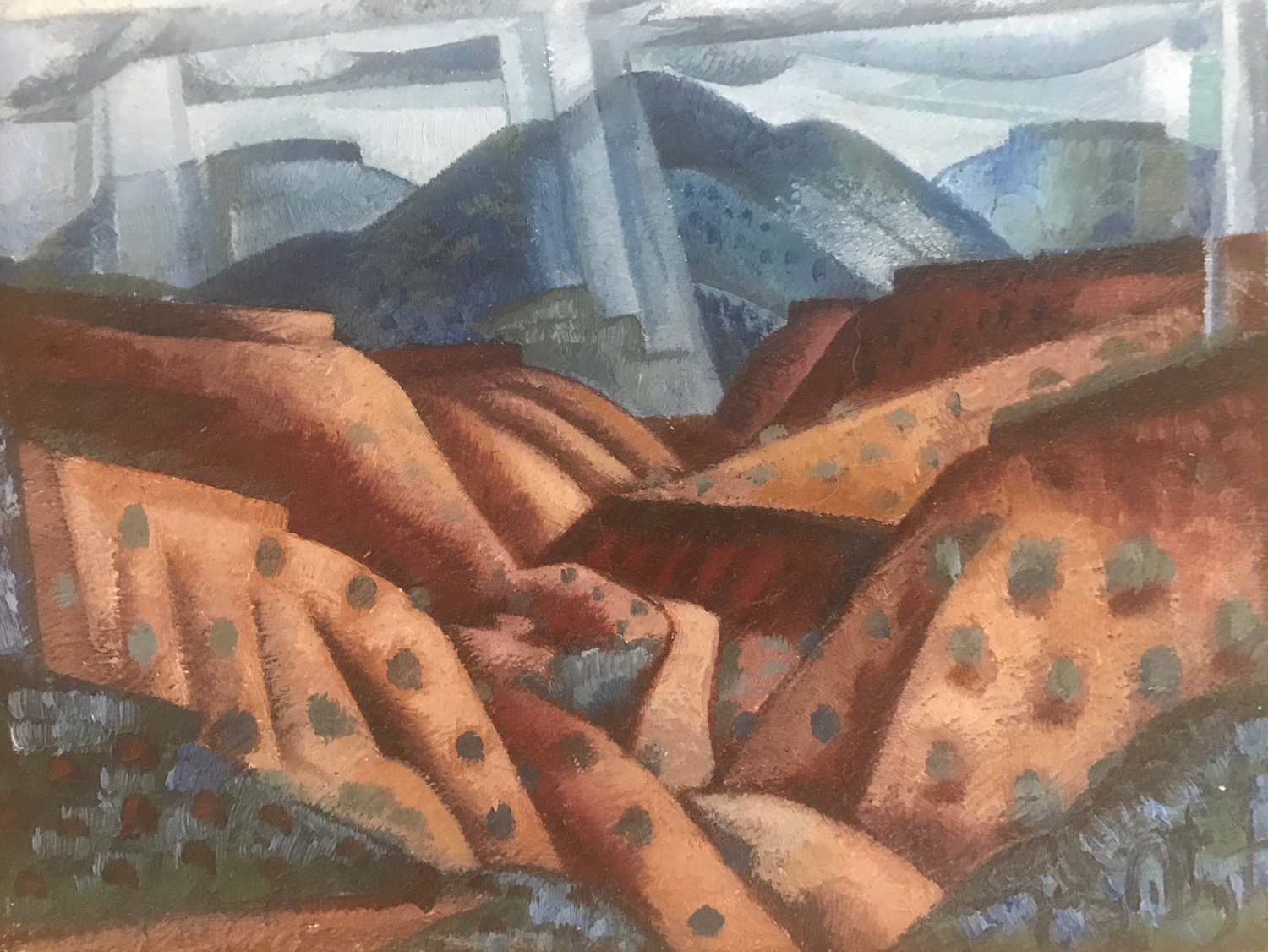
Doesn't this glorious abstract landscape painting from the Pantages Portfolio just rock your world? This breathtaking piece, titled "Path Through the Mesas" was painted by Navajo contemporary artist Tony Abeyta in 2001.
Abeyta is known for his mixed media works that highlight the beauty of the American Southwest. According to the painter, "There exists a rhythm in the land where I was born. I spend a lot of time deciphering the light, the cascades of mesas into canyons, the marriage between earth and sky and the light as it constantly changes at whim, the intensity of rock formations, and the sage and chamisa that accent this poetic experience, unlike any where else I have seen. I am beckoned to remember it and then to paint it." Abeyta received the New Mexico Governor’s Excellence in the Arts award in 2012 and has been recognized as a Native treasure by the Museum of Indian Arts & Culture. His work has been shown at Blue Rain Gallery in Santa Fe, NM, and is included in the Smithsonian’s National Museum of the American Indian, the Museum of Fine Arts in Boston, the Heard Museum in Phoenix, AZ, New Mexico Fine Arts Museum, the Autry Museum in Los Angeles, CA, and the Eiteljorg Museum in Indianapolis, as well as many other public and private collections.
Tuesday, July 3, 2018
The View From Here
Come take a look - the view is delightful! This could be said both about this three-panel hinged painting by Bernard Chaet, as well as the entire Pantages Portfolio! This work, accurately entitled "Panorama," is colorful and upbeat - and in a way has a "selfie" feel to it, given its perspective and angle.
American artist Bernard Chaet (1924-2012) is best known for his colorful, modernist figure and animal paintings. He taught for over four decades as a Professor of painting at Yale University in New Haven, CT; he was also chair of the school's art department. He won many awards over the course of his lifetime, including a Sabbatical Grant from the National Foundation of the Arts and Humanities, the Benjamin Altman Award in Painting from the National Academy of Fine Arts, and the Jimmy Ernst Prize from the American Academy of Arts and Letters. He was also named a National Academician by the National Academy of Design in 1994. Examples of Chaet's work can be found at the Museum of Fine Arts in Boston, the Metropolitan Museum of Art in NYC, the Art Institute of Chicago, and the Smithsonian American Art Museum in Washington, D.C., among many others.
Monday, June 11, 2018
Full House
There's no place like home, where ever that may be. This thoughtful painting of an urban "full house" is another highlight from the remarkable Pantages Portfolio. This Edmund Quincy work features six people - but who knows how many more are working, playing, or sleeping within the structure as well?
Edmund Quincy (1903-1997) was somewhat of a renaissance man. He is probably best known as a portrait, townscape, and landscape artist, but he also wrote and published poetry and fiction. Quincy attended Harvard University and graduated in 1925. He also studied at the Students League and with Albert Herter, Georges Degorce, George Noyes and F. Whiting. Quincy spent much of his later life and time living and painting in Italy.
Thursday, May 24, 2018
Playing The Name Game
"Deciphering" and cataloging the Pantages Portfolio is a both a labor of love, as well as hard work. All of the paintings in this collection share several common threads - they are eye catching, well composed, and make you think. However, many of them are not signed, or are signed in such a way that is is extremely hard to read. This is where my wife Judy really shines.
This blog post features a few of these "mystery" works. Perhaps you can help shed a little light on them?
Judy Smith is one of the best in the business when it comes to looking at a painting and doing the detective work that is so often required to really understand and document it. Being able to interpret some initials, translate an illegible signature, or attribute a painting based on style and technique alone are exceedingly rare talents. You must have patience, tenacity and intuition to be a good researcher, and Judy simply embodies these important traits. Oh, and by the way, she loves every minute of it. There is no happier Judy than when her research pays off!" - Peter Smith
Tuesday, May 1, 2018
Two For One, or, Frustrating and Fabulous
"You have already heard me say this a few times already, but our collector James Pantages has an incredible eye for art. He also has a kind of innate sort of brilliance art lovers can only dream about. Mr. Pantages always bought the art and not the artist. He could not care less who created the work; if the image did not speak to him he simply moved along.
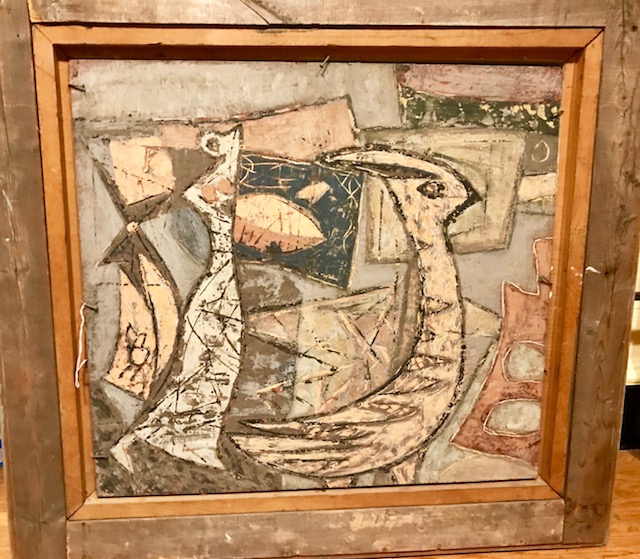
So here we go again with another anonymous collection highlight. This early midcentury two-sided oil on board painting is a prime example of a "yet to be figured out" unknown talent. Who paints something this amazing and doesn’t sign it? Personally, this makes me crazy, mostly because I love it so much and want to fill in the blanks. So often just knowing who created the work helps to explain subtleties about the picture that may not be so obvious. My friend and art expert Colleen Fesko and I agree it is so far one of our favorites. If anybody has thoughts on who painted this superb abstract please let us know." - Peter Smith
Subscribe to:
Posts (Atom)